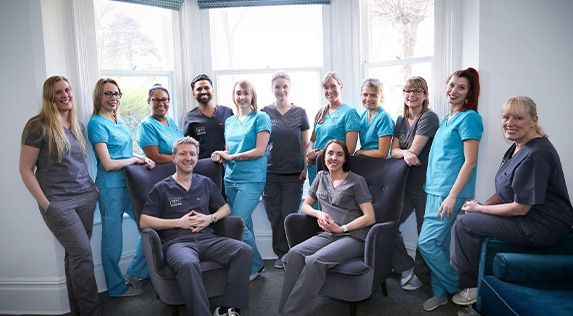
There are patients who arrive at East Park Dental who haven’t been to a dentist in 20 or 30 years. Their teeth may be severely worn, some may be missing entirely, and what remains might be causing pain or embarrassment. Smiling in photos feels unthinkable. Eating comfortably is a daily challenge. Social situations are a source of anxiety rather than pleasure.
For these patients, full mouth rehabilitation isn’t just a dental procedure, it’s life-changing. Hiren Vaghela, our prosthodontist at East Park Dental, specialises in these complex, comprehensive cases, rebuilding smiles from the ground up and restoring the function, aesthetics, and confidence that patients thought they might never have again.
Full mouth rehabilitation, sometimes called full mouth reconstruction, is a comprehensive treatment approach that addresses the entire mouth rather than individual teeth in isolation. It typically involves a combination of crowns, bridges, dentures, and dental implants, all carefully planned and sequenced to rebuild the bite, restore appearance, and achieve long-term stability.
Unlike a single crown or bridge, full mouth rehabilitation requires detailed assessment of the occlusion (how the upper and lower teeth meet), the condition of all remaining teeth and tissues, and the patient’s overall dental and medical history. Everything is considered together, because changing one part of the mouth affects the rest of it.
Full mouth rehabilitation is typically considered when dental problems have progressed to a point where straightforward treatments are no longer sufficient on their own. Patients who commonly benefit include those who have experienced:
Significant tooth wear caused by grinding (bruxism), acid erosion, or a combination of both, leaving teeth visibly shorter, more sensitive, and increasingly fragile. Patients with severe tooth wear often have little remaining tooth structure and need their entire bite rebuilt to regain normal height and function.
Multiple failing restorations, where previous crowns, bridges, or other dental work has deteriorated over time. In cases like this, a staged approach is needed, carefully assessing what can be saved and what needs to be replaced before rebuilding the mouth systematically.
Significant tooth loss, particularly where missing teeth have caused the remaining ones to shift, the bite to collapse, or the face to take on a sunken appearance. Full mouth rehabilitation in these cases often involves implants alongside conventional restorations.
Complex bite issues, where the relationship between the upper and lower jaws makes it difficult to place conventional restorations without first creating the right amount of space and ensuring forces are distributed correctly across the teeth.
Every full mouth rehabilitation at East Park Dental begins with a thorough consultation. Hiren takes the time to understand what the patient is experiencing, what they want to achieve, and what their dental history looks like. Clinical photographs, X-rays, and a detailed examination of the teeth and soft tissues all form part of the initial assessment.
From there, a bespoke treatment plan is developed. This sets out the sequence of treatment, all available options at each stage, the risks and benefits of each approach, and the associated costs, so that patients can make fully informed decisions before anything begins.
Treatment is then carried out in carefully planned stages. This might begin with bringing the gums and any existing disease under control, followed by the placement of temporary restorations to test the proposed bite and aesthetics. Once everything is functioning well and the patient is happy, the final, permanent restorations are placed.
Throughout the process, the patient is never working with their mouth in a compromised or uncomfortable state. Temporaries provide both protection and a preview of the final result.
To give you a sense of what full mouth rehabilitation can involve, Hiren describes one of the more challenging cases he has completed:
“The patient had significant tooth wear, a pre-existing implant, and multiple crowns and bridges that were all failing. The first step was to dismantle what was there, assess what we could actually work with, and then rebuild carefully from that foundation. The finished result involved crowns, bridges, and implants, a complete rebuild of the mouth, done in a fully controlled way, from start to finish.”
Cases of this complexity typically take between 18 and 24 months from the initial consultation to the placement of final restorations. That timeline allows for tissues to heal properly at each stage, for the bite to be thoroughly tested, and for all the detailed laboratory work involved to be completed without rushing.
The physical results of full mouth rehabilitation, being able to eat comfortably, speak clearly, and smile without self-consciousness, are transformative in themselves. But the emotional impact is often just as profound.
Patients who have hidden their smiles for years, who have avoided certain foods, or who have felt embarrassed in social situations, often describe a remarkable shift in confidence after treatment. Being able to smile fully, laugh openly, and eat without thinking about it are things many of us take for granted, but for patients who have been without those freedoms, regaining them can feel like a completely fresh start.
As Hiren puts it: “Seeing that journey from start to finish, knowing where someone began and seeing where they are at the end, that’s what makes this work so rewarding.”
Full mouth rehabilitation is a significant investment of both time and money, and protecting that investment through good long-term maintenance is essential. Hiren advises all patients to brush twice daily with a fluoride toothpaste, to use interdental aids such as floss or interdental brushes, and to attend regular hygiene and check-up appointments so that the restored dentition can be monitored and kept in excellent condition.
Regular hygienist visits are particularly important after full mouth rehabilitation, professional cleaning helps to protect the work that has been done and ensures that any early signs of problems are caught before they become significant.
If you’ve been told in the past that your dental problems are too complex to treat, or if you have simply been living with a smile you’re unhappy with because you didn’t know there was a solution, a consultation with Hiren Vaghela at East Park Dental may be the first step toward a real change.
We welcome direct patient enquiries as well as referrals from other dental practices across Northampton and the surrounding areas. Our team will take the time to understand your situation fully, explain all of your options clearly, and help you decide whether full mouth rehabilitation is the right path for you.
To find out more or to book a consultation, please contact East Park Dental today. Your journey to a healthier, more confident smile can start here.